

Celebrating 30 Years of First Nation Leadership in Land Governance
On May 5, 2026, the Chippewas of Georgina Island First Nation hosted a celebration gathering for the 30th anniversary of the Framework Agreement on First Nation Land Management (Framework Agreement).
Held in the very hall where the Framework Agreement was originally signed on February 12, 1996, the event carried deep meaning for many in attendance. Returning to Georgina Island, where this historic journey began, served as a powerful reminder of how far First Nations have come over the past three decades.
The gathering welcomed Directors of the Lands Advisory Board (LAB), representatives from the First Nations Land Management Resource Centre (RC), community members of the Chippewas of Georgina Island First Nation, and federal ministers the Honourable Mandy Gull-Masty and Honourable Rebecca Alty and staff.
Together, they reflected on a shared history that has transformed land governance for First Nations across Canada.
Taking Back Control over Lands and Resources
The Framework Agreement emerged from the vision and persistence of First Nation leaders seeking a new path forward, one where their communities could move beyond the restrictive land management sections of the Indian Act to exercise their inherent authority over their lands, natural resources, and environment.
Thirty years later, that vision has evolved into one of the most significant First Nation-led governance initiatives in Canada.
What began with just 13 original signatory First Nations has grown into a national movement of more than 220 signatory communities. Now, 132 First Nations are operating under their own land codes, while four have advanced into comprehensive self-government agreements. Together, participating communities govern more than 1.2 million acres of reserve land under their own laws and governance systems.
The anniversary celebration reflected not only on this remarkable growth, but also on the enduring importance of land governance as a foundation for cultural continuity, environmental stewardship, community well-being and economic development.

(Click to review the 30th Anniversary Signatory Map)
Clearing the way
Holding the event on Georgina Island First Nation was especially meaningful.
The community has long been recognized as a leader in advancing First Nation jurisdiction over lands and resources. On March 11, 1997, the Chippewas of Georgina Island First Nation became the first signatory community to vote on and approve a land code under the Framework Agreement, followed only minutes later by neighbouring Mississaugas of Scugog Island First Nation, who did the same.
These early successes helped pave the way for First Nations across the country to pursue opportunities under the Framework Agreement to restore authority over land management, environmental protection, economic planning, and cultural stewardship in ways that reflect their own traditions and responsibilities to future generations.
Restoring Authority, Strengthening Nations.
Throughout the celebration, speakers reflected on both past achievements and ongoing efforts.
Chief Donna Big Canoe gave opening and closing remarks, relaying the impacts that the Framework Agreement and the Chippewas of Georgina Island Land Code have had on her community. She thanked the leadership of the LAB for their influential work in creating space for First Nations to move forward with self-governance over lands on their own terms.
LAB Chairman Chief Robert Louie of Westbank First Nation acknowledged the accomplishments and challenges of the last three decades, while emphasizing the determination of First Nation leadership to continue advancing solutions and strengthening governance.
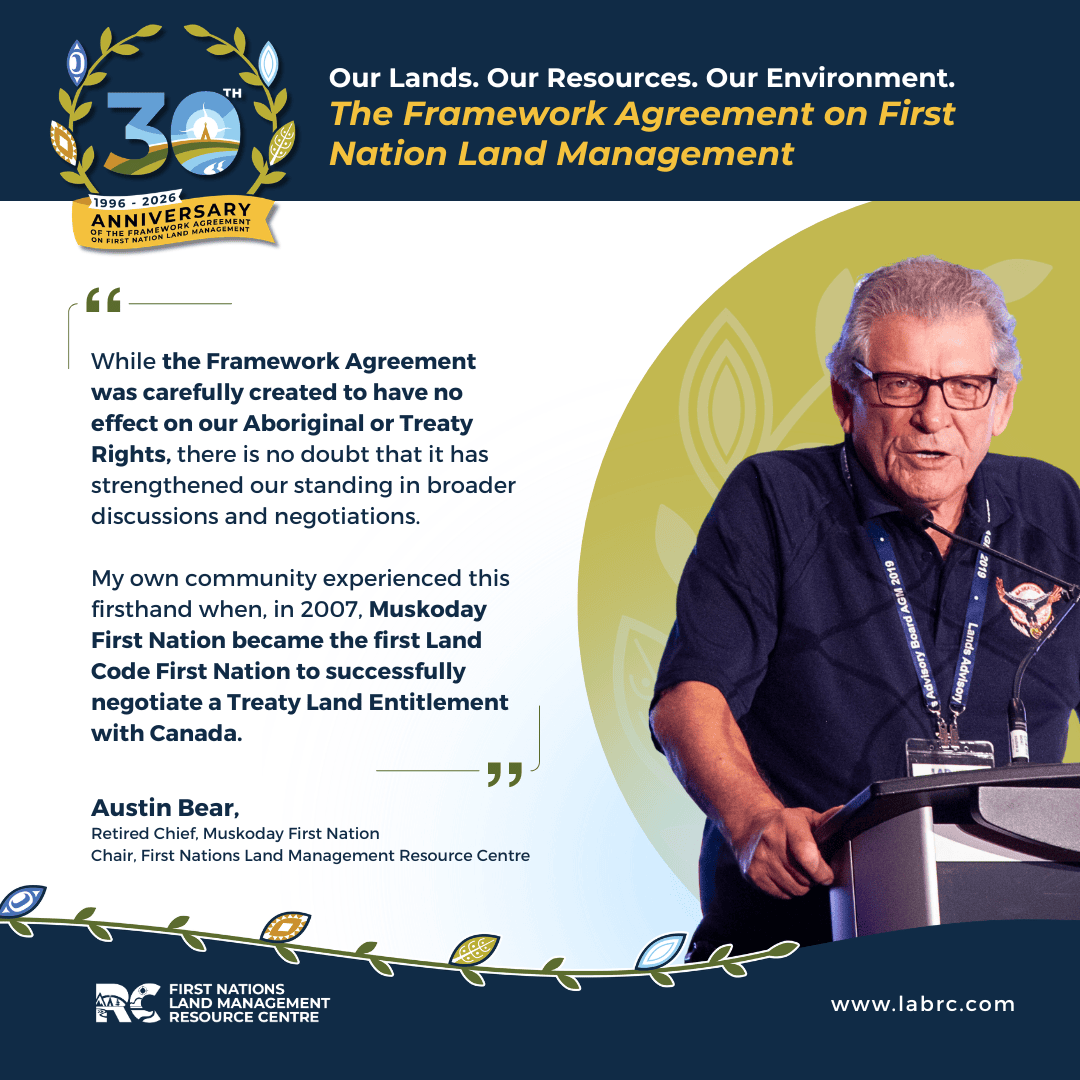
RC Chair and retired Chief of Muskoday First Nation, Austin Bear, spoke about the profound impact land governance has had on communities like his own. He reflected on the growth of the movement from the original 13 signatories to more than 220 participating First Nations today, and on how reclaiming governance authority has strengthened communities across the country.
“When we passed our land code, Muskoday held a community celebration,” he shared. “Members of all ages, from Elders to children, took part as we burned the Indian Act. It was a powerful, healing, and symbolic moment. We honoured the struggles of the generations before us and reasserted our responsibilities to the generations yet to come.”
His remarks highlighted how reclaiming governance authority extends far beyond administration. It is deeply connected to healing, identity, and nationhood.
Retired Chief of Georgina Island First Nation, LAB Director Councillor William McCue echoed those sentiments, reflecting on why his community chose to support the Framework Agreement from the beginning.
“We supported it because it returned jurisdiction. Because it restored authority. Because it put decision making back where it belongs, in the hands of our people,” he said.
Councillor McCue emphasized that while economic development opportunities have followed, the true value lies in communities being able to decide for themselves what should be protected, developed, and prioritized according to their own values and traditions.
Minister of Indigenous Services, the Honourable Mandy Gull-Masty, and Minister of Crown-Indigenous Relations Rebecca Alty each expressed their continued support for the Framework Agreement while also recognizing key issues related to First Nations land governance and congratulating communities on the Framework Agreement’s impact.
(Statement on the 30th Anniversary of the Framework Agreement on First Nation Land Management)

(LAB Directors Councillor William McCue and Chief Kelly LaRocca with LAB Legal Advisor William Henderson)

(Click to review Framework Agreement Quick Facts)
Moving Forward Together
Over the past 30 years, communities operating under land codes have demonstrated the transformative benefits of First Nation-led land governance.
Participating First Nations can advance housing, infrastructure, environmental protection, land use planning, and economic development projects more efficiently, while ensuring decisions remain accountable to their citizens and grounded in community priorities. These improvements greatly benefit not only First Nations, but neighbouring regions and Canada as a whole.
The anniversary celebration highlighted the importance of the evolving partnership between First Nations and Canada. Speakers acknowledged the collaborative relationships built over the years with ministers, government officials, and staff who helped support the implementation and continued advancement of the Framework Agreement.
Before the celebration concluded, leaders thanked the federal officials who had recognized and supported this work over the past 30 years. Leaders noted that the anniversary was shared with all those who helped advance the vision of the Framework Agreement from its earliest days.
From the late Minister Ron Irwin, who worked alongside First Nation leaders to sign the historic government-to-government agreement in 1996, to the Ministers present at the anniversary gathering, many were recognized for helping foster the spirit of partnership that has guided the Framework Agreement forward for over three decades.
That spirit of collaboration has played an important role in shaping one of the most successful First Nation-led governance initiatives in Canada, built on the recognition of First Nation jurisdiction over lands and governance.
A Legacy That Continues to Grow
Thirty years after its signing on Georgina Island, the Framework Agreement continues to stand as a powerful example of what can be achieved through First Nation leadership, vision, and persistence.
At its heart, the agreement is about far more than land administration.
It is about restoring jurisdiction. Strengthening nations. Protecting lands and cultures. And ensuring future generations inherit not only lands, but the authority and resources to govern them.
On behalf of the LAB, Chairman Louie concluded his remarks by reaffirming the Board’s resolute commitment to implementing the new First Nation Land Governance Registry, advancing reform to Canada’s harmful additions-to-reserve process, and securing critical advancements in the enforcement of First Nation laws. While recognizing the significant progress achieved over the past 30 years, he emphasized that the work is far from complete.
As participants reflected on the past three decades, there was a strong sense of pride not only in what had been achieved but also in how it had been achieved through persistence, partnership, and a shared commitment to building a stronger future for First Nations communities.
And in that same spirit, leaders emphasized, the work will continue, together.

(LAB Directors, special guests, and Minister Gull-Masty gather at the Chippewas of Georgina Island First Nation to celebrate the 30th Anniversary of the signing of the Framework Agreement on First Nation Land Management.)
For more information on the 30th Anniversary of the Framework Agreement on First Nation Land Management and the May 5th celebration, please explore the links below:
30 Years of the Framework Agreement on First Nation Land Management
Framework Agreement on First Nation Land Management
First Nations Land Management Resource Centre
30 Years of Land Governance Timeline
Video: 30th Anniversary of the Framework Agreement
Special 30th Anniversary Edition: The Lands Advisor Newsletter
(Click to play the 30th Anniversary Celebration video of addresses by leadership.)