


150 Years of Indian Act Control. 30 Years of First Nations Taking it Back!
150 Years of Indian Act Control.
On April 12, 2026, Canada quietly reached a solemn milestone that should have demanded national reflection: 150 years since the passage of the Indian Act. There were no celebrations and little official recognition. The silence itself spoke volumes. This is not a history to celebrate with pride, but one that must be faced with honesty. Its impacts are woven through the country’s history and institutions, and they continue to impact the lives of First Nations peoples today. It is a legacy that cannot be ignored.
The Indian Act was designed to assimilate First Nation populations, dismantle and outlaw their traditional governance systems, and consolidate federal control over their land to enable Canada’s expansion. It opened vast territories for settlement, industry, investment, and resource extraction without the consent of First Nations. While Canada grew in wealth and stability, First Nations bore the cost.
The cost was not temporary, but generational. Policies imposed under the Indian Act disrupted families, governance systems, and economies, compounding harm over time. Movement was restricted, cultures suppressed, and land connections severed. Policies like the residential school system produced trauma that continues today. Decisions once guided by traditional knowledge and responsibility became federally controlled. Progress was significantly delayed, and opportunities lost. The connection between land, governance, and culture was intentionally fractured.

30 Years of First Nations Taking it Back!
Despite these challenges, First Nations’ connection and relationship with the land endured. For decades, First Nations have worked to assert their inherent rights, jurisdiction and responsibilities over lands. Over 30 years ago, this spirit of determination established the Framework Agreement on First Nation Land Management, offering a First Nations-led path to reclaim jurisdiction over their lands, natural resources and environment. Today, more than 220 First Nations participate in this growing movement.
The Framework Agreement enables participating communities to develop and implement land codes, providing a practical means to move beyond the controlling land management sections of the Indian Act. Through land codes, First Nations replace over one-third of the Indian Act with their own laws and exercise federally recognized self-governance, making decisions on their own terms.
The results are tangible: housing and infrastructure projects proceed efficiently, jobs are created, investment grows, and local economies strengthen. Communities protect their lands, preserve environmentally significant areas, and lead conservation efforts grounded in traditional knowledge.
This is not theory; it is measurable change. When jurisdiction is restored, communities thrive. Land Code First Nations are building sustainable futures while contributing to broader growth. This is self-governance in action.
It is important to be clear about what this work does and does not change. Land Codes developed under the Framework Agreement do not alter constitutional protections related to status or lands reserved for “Indians.” These protections remain fully intact. Treaty rights are unchanged. The Crown’s constitutional obligations remain in place.
What does change is governance. Authority over land use and development shifts from federal control to First Nations. Communities manage their lands under their own laws, guided by local priorities and cultural values. The result is the restoration of jurisdiction to those with the deepest ties to the land, not the removal of safeguards.
Over the last 30 years, there has been meaningful progress. Within federal and provincial systems, individuals are working with First Nations to support change. Policies and relationships have evolved; recognition of First Nation rights and jurisdiction continues to grow. But recognition alone is not reconciliation. There is both an opportunity and a responsibility for Canada to go further.
Ongoing Reforms
Reform must begin with processes such as Canada’s Additions to Reserve (ATR), which continues to be cumbersome and bogged down in bureaucratic red tape. ATRs are essential to the future of First Nations and to Canada’s evolving economic growth. To expand their land base, First Nations often must repurchase lands that were historically theirs, absorb fees and ongoing tax burdens, and navigate federal approval processes that can take years or decades to complete. These delays often negatively impact housing, economic development, social programming, and long-term planning. They are not isolated inefficiencies, but contemporary expressions of the control embedded throughout the Indian Act. Streamlining ATR is both a matter of fairness and a practical step toward reconciliation, unlocking economic potential and positioning First Nations as full partners in building a stronger, more inclusive Canadian economy.
The ability to enforce First Nations laws is equally essential to the exercise of jurisdiction. Without effective enforcement, significant risks of harm persist. Trespassers, drug activity, dangerous housing conditions, illegal dumping, vandalism and more present real and ongoing threats. Where enforcement barriers exist, serious crimes tend to follow. Effective enforcement is not only a matter of jurisdiction; it directly affects safety, community wellbeing, and investment in economic development, benefits that extend to neighbouring communities as well.
Continued support of First Nations‑led institutions, including the First Nations Land Governance Registry, is essential to the effective exercise of jurisdiction. Developed under the Framework Agreement, the Registry reflects First Nations jurisdiction and legal frameworks, ensuring that legal documents, leases, permits, and other land-related instruments are accessible, enforceable, and recognized by third parties, including investors, lenders, and governments. By providing clarity, certainty, and accountability, it upholds First Nation laws, supports economic development, and strengthens First Nations’ land governance.
The Way Forward
True partnership between Canada and First Nations to move past the detrimental effects of the Indian Act requires a shift in the status quo. Consultation cannot remain procedural. It must become a meaningful process in which First Nations shape outcomes from the outset. This requires shared decision-making and the removal of barriers that continue to limit the full exercise of jurisdiction.
Land Code First Nations show what’s possible when communities lead.
The legacy of the Indian Act cannot be erased. It is as embedded in Canada’s history as the crimson red of its flag. But it does not have to define its future.
Over the past 30 years, a different path has emerged. One where First Nations govern their lands, strengthen their economies, and protect what matters most to future generations. It is a path that benefits not only First Nations but all Canadians.
The way forward is clear, and it leads toward a future no longer defined by the Indian Act.
(Click for more information on the upcoming conference)
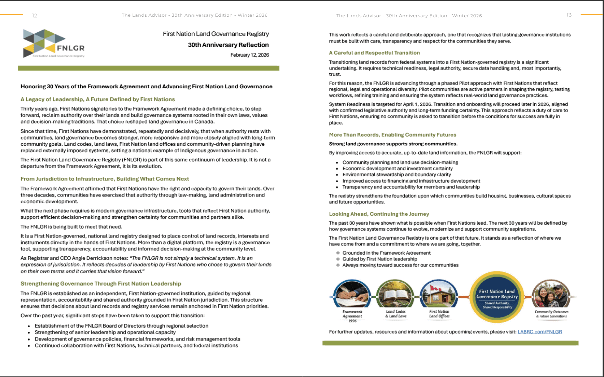
(Click to review the FNLGR Framework Agreement 30th Anniversary Update)
For more information, please explore the following links:
The 30th Anniversary of the Framework Agreement
Special 30th edition: The Lands Advisor Newsletter
Quick Facts about the Framework Agreement on First Nation Land Management